When we walk the streets with a camera, our eyes are easily overwhelmed by the sheer volume of movement. We look for faces, emotional expressions, or sudden gestures. However, the most profound street photographs often happen when the photographer stops chasing the crowd and looks instead for the permanent graphic patterns built into the city itself.
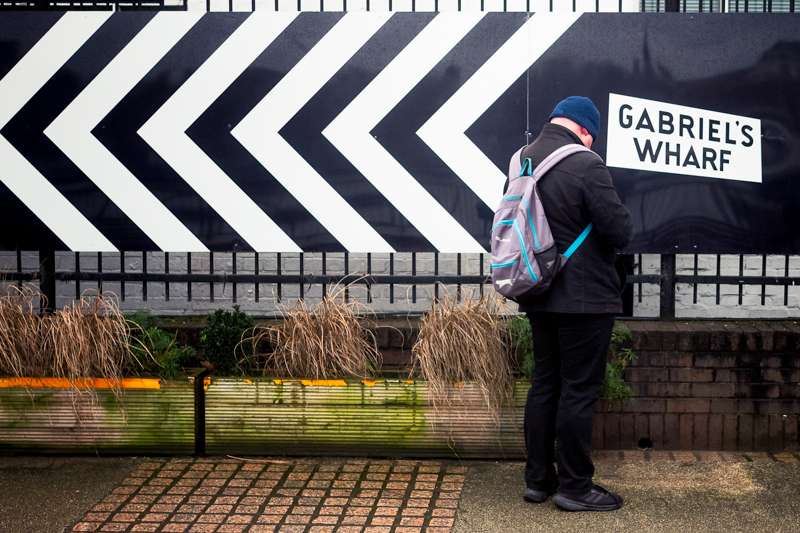
This image, captured along London’s South Bank near Gabriel’s Wharf, serves as a masterclass in how environmental graphic elements can be used as visual anchors to trap, hold, and direct the viewer's eye.
By dissecting the anatomy of this frame, you can learn how to shift your own work from reactive snapshots to intentional, high-contrast fine art.
Anatomy of the Frame: Chevrons and Typography
The strength of this composition lies in its strict, two-part division of the background. On the left, we have a massive, rhythmic pattern of black-and-white chevron arrows. On the right, we have a clean typographic anchor: a white sign reading "Gabriel's Wharf."
In the Flâneur Method, this is what we call an environmental trap. The chevron arrows possess immense kinetic energy; visually, they act like a repeating conveyor belt pushing the viewer’s gaze forcefully from left to right.
Left unmanaged, this graphic pattern would push the viewer's eye straight out of the right side of the frame. But notice what stops the momentum: the vertical block of the human subject and the literal text anchor. The sign acts as a visual brake, balancing the frame and keeping the viewer's eye circulating within the boundaries of the photograph.
💡 Actionable Advice for Your Next Walk:
When you are looking for graphic backdrops in your city, don't just look for blank walls. Seek out heavy contrast boundaries. Look for:
- Directional Signage: Arrows, crosswalk lines, and chevrons that create artificial motion in a static frame.
- Environmental Text: Clean bold typography on walls or windows that acts as an intellectual anchor for the composition.
- Juxtaposition of Forms: How organic human shapes break up the rigid, geometric perfection of man-made patterns.
The Posture of the Flâneur
The human element in this photograph is vital, not because of who the subject is, but because of his posture. He is the quintessential quiet observer. With his head tilted down, his backpack on, and his body turned toward the wall, he is completely wrapped in his own world.
Because he is looking down, his face is hidden. In street photography, hiding the face is an advanced technique that increases the universality of the image. The moment the viewer cannot see the subject’s eyes, they stop looking at a stranger's portrait and start mapping their own emotions onto the silhouette. He becomes a symbol of the urban wanderer—the flâneur navigating the graphic maze of the modern city.
How to Execute This: The Geometry-First Mindset
This photograph was not captured by chasing a man down the sidewalk. It was executed by applying the background-first technique taught in our training programs.
The process was simple: I found the striking chevron wall first. I locked down my composition, made sure the horizon line of the brick planters was perfectly level, and adjusted my exposure compensation to keep the whites crisp and the blacks deep. Then, I simply waited. I waited until a solitary figure entered the right third of the frame and paused in a posture that matched the quiet mood of the space.
Want to Change How You Compose the Streets?
Stop guessing your compositions. Learn how to identify graphic traps, use architectural scale, and master the art of patience with our structured field assignments.
Explore The ToolkitsIf you train your eyes to see geometry first and humanity second, your street photography will immediately lose its frantic energy. Your images will gain structure, depth, and a timeless graphic quality that stands out in a world saturated with messy snapshots.