Night street photography often poses a difficult choice for introverted photographers: crank up the ISO to noisy levels, or miss the fleeting human stories altogether. However, urban environments offer a massive, overlooked asset that can transform your night portfolio: the local food stall.
In this case study from a vibrant evening market in Amsterdam, we analyze how a hot dog trailer can serve as a professional studio light source, and how to elegantly manage sudden eye contact without panicking or lowering your camera.
1. The Food Stall as a Softbox
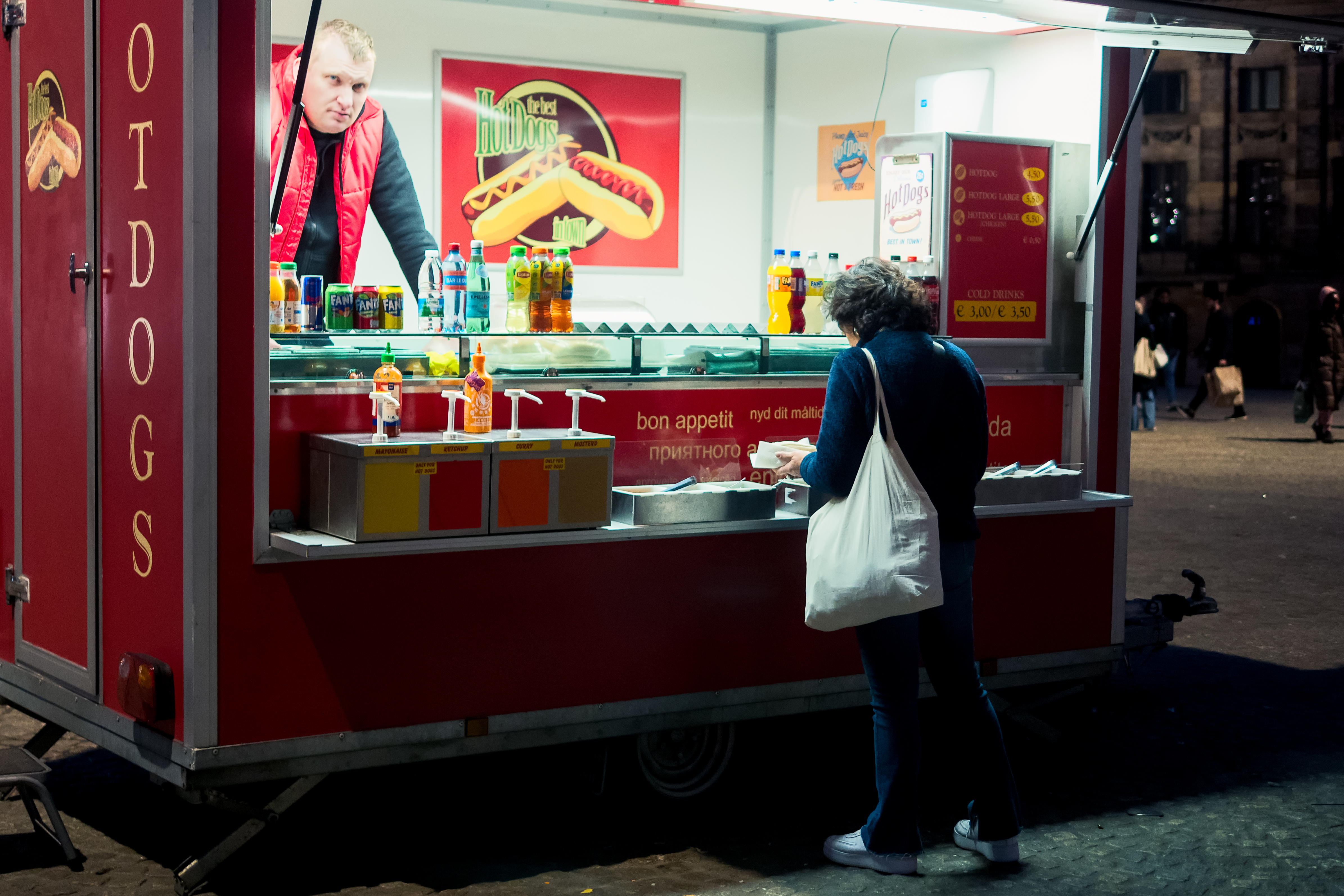
Look at the composition above. The interior of the hot dog trailer is flooded with bright, diffused white light. It acts as a giant, cinematic softbox in the middle of a dark square. Instead of trying to illuminate the entire background, the Flâneur approach dictates that you treat the stall as your stage.
By exposing your camera strictly for the illuminated interior, the surrounding dark square falls naturally into deep shadow. This creates an instant, high-contrast visual anchor that separates your subject—the customer waiting patiently for her order—from the chaotic background noise.
Field Exercise: The Lightbox Method
- Step 1: Find a glowing food truck, waffle stand, or kiosk at night.
- Step 2: Set your exposure (Spot Metering) to the brightest parts of the stall's interior. Let the night wrap the rest in shadows.
- Step 3: Stand back in the dark area, plant your feet, lock your frame, and wait for a human element to enter the light beam.
2. Overcoming the Vendor’s Gaze
One of the biggest fears for quiet observers is the moment the subject looks back. In this frame, the vendor caught me mid-composition. His gaze is intense, sharp, and direct. For many introverts, this trigger causes them to instantly lower the camera, look at the ground, and walk away with a racing pulse.
But notice the dynamic: I did not lower the lens. When a vendor spots you, the secret is to hold the frame for two seconds longer. If you click and immediately drop the camera like a guilty thief, you validate their suspicion. If you hold the camera still, compose calmly, and follow the click with a polite nod of gratitude or a warm smile, the interaction transforms from an intrusion into a shared, artistic moment.
The customer remains a beautiful profile silhouette, focused on her food, completely unaware of the visual dialogue between the vendor and the lens. This layering of awareness is what gives a photograph its lasting narrative tension.