
The traditional myth of the street photographer is loud, fast, and intensely visible. We’ve all seen the social media clips: a photographer stepping directly into a stranger’s path, flash in hand, snapping a picture from arm's length, and walking away before the subject even realizes what happened. It is an approach built on adrenaline, speed, and a "hit-and-run" mentality.
For an introvert, just watching that style of shooting can induce a wave of social anxiety.
If you are a quiet observer by nature, the idea of invading someone's personal space feels deeply uncomfortable. For years, this discomfort has led many talented photographers to believe that street photography simply isn't for them. They look at the crowded streets and see an intimidating stage where they are forced to be reluctant actors.
But there is another way. A quieter, far more sustainable approach. It’s called The Flâneur Method.
The Shift: From Hunter to Observer
The secret to overcoming shooting anxiety on crowded streets lies in changing your core metaphor. You need to stop viewing yourself as an aggressive hunter chasing a target, and start viewing yourself as a quiet observer documenting a landscape.
When you approach street photography as a hunter, your body language betrays you. You look tense. Your eyes dart around guiltily. You raise the camera nervously and drop it quickly as if you’ve done something wrong. Ironically, this anxious energy is exactly what makes you stand out in a crowd. People notice tension; they instinctively look at someone who looks like they are hiding something.
When you adopt the mindset of the flâneur—the deliberate, passionate urban stroller—everything changes. Your body language becomes relaxed. You are no longer looking at people with predatory focus; you are looking at the entire scene: the way the shadow cuts across the pavement, the geometry of the architecture, the rhythm of the city.
You aren't a threat to the scene; you are a part of it.
The Background-First Technique
One of the most practical ways to lower your anxiety immediately is to practice background-first composition.
Instead of walking around looking for interesting people to snap, find an interesting piece of light or geometry first. Look for a dramatic shadow cast by a building, a beautifully framed archway, or a minimalist wall reflecting afternoon light.
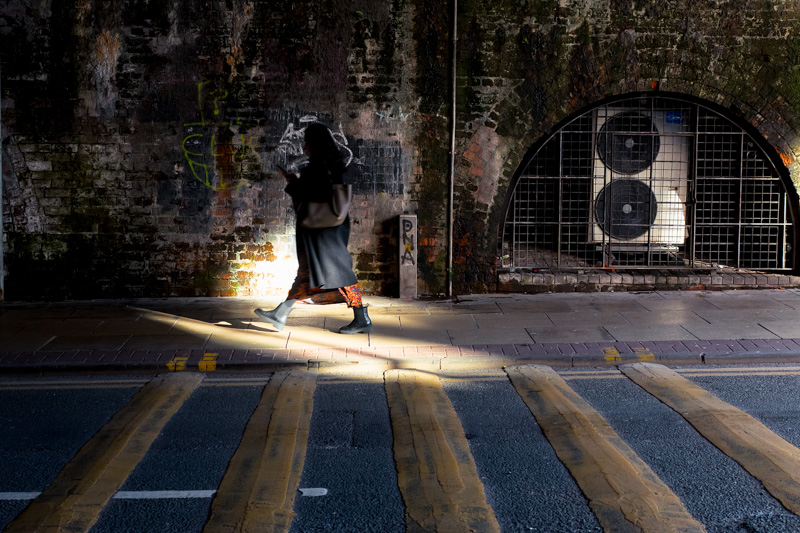
Once you find your frame, set up your composition. Raise your camera, adjust your exposure, and look through the viewfinder.
Now, you wait.
To the passing crowd, you are no longer a photographer taking pictures of them. You are simply a photographer taking a picture of the architecture. You have become a static element of the street. When a person finally walks through your perfectly composed pool of light, you simply press the shutter.
Because the camera was already raised before they entered the frame, they won’t feel targeted. They will think they merely walked into your shot.
The Introvert's Superpower
Introversion is not a barrier to street photography—it is your secret weapon.
While extroverted photographers might rely on charm or pure speed, an introvert excels in situational awareness and patience. Because you have no desire to be the center of attention, you are able to blend into the background in a way that louder photographers simply cannot. You have a natural ability to notice those small, quiet moments and subtle gestures that others rush past.
The next time you step out with your camera, take a deep breath. You do not need to be loud, aggressive, or fast.
You just need to disappear.